


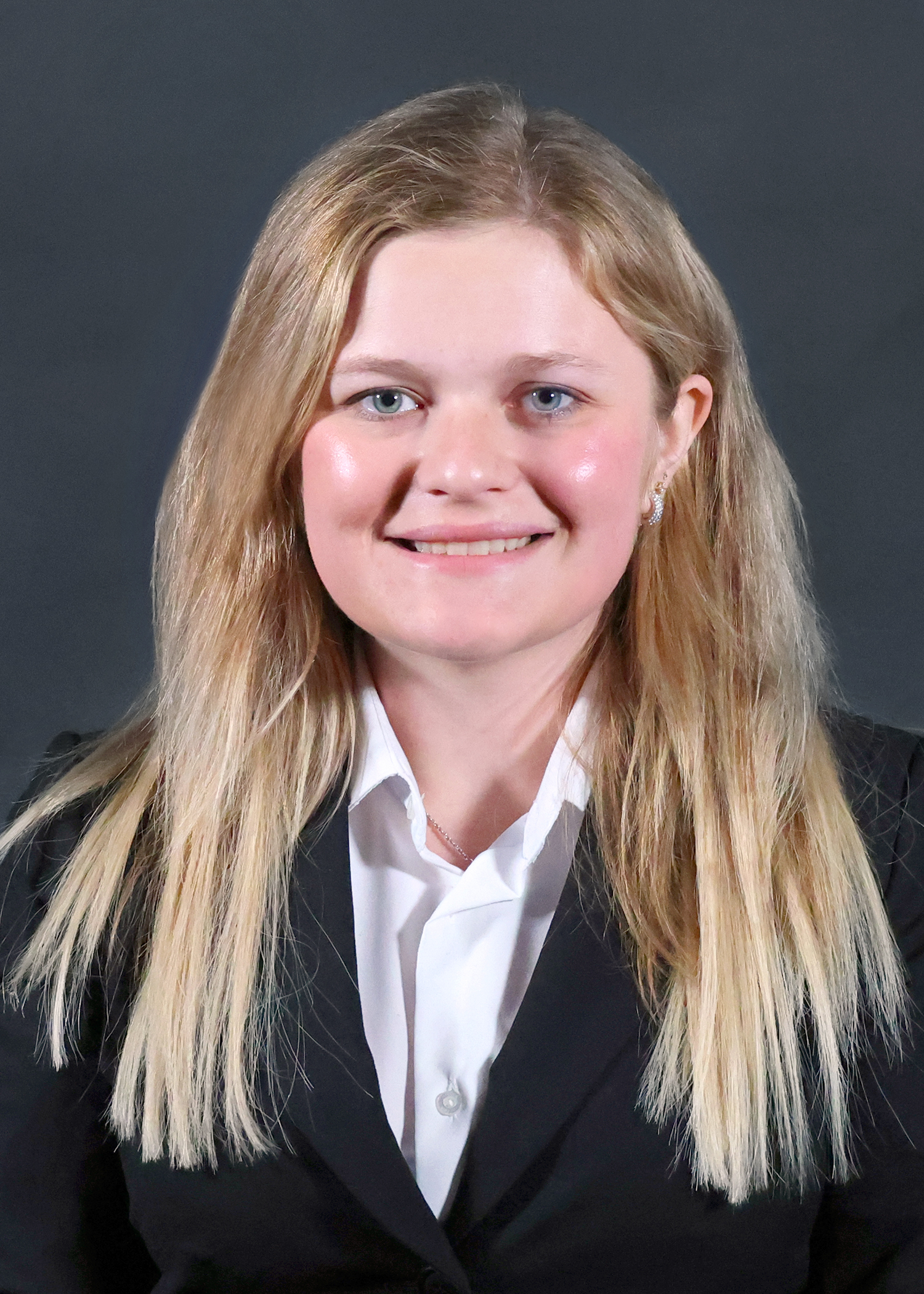
BCoE Student Hall of Fame 2026: Karly Mims
April 28, 2026
Congratulations to the 2026 Bagley College of Engineering Student Hall of Fame class!
Over the next few days, we will be highlighting each SHoF recipient.
The new members participated in a Q&A reflecting on their time at Mississippi State.
Karly Mims
What is your name, age, classification and major?
My name is Karly Mims, and I am 23 years old. I am currently a senior at Mississippi State University, pursuing a dual degree in biosystems engineering and mechanical engineering, with a minor in mathematics.
What year did you begin studying at MSU, and when is your expected graduation date?
I started studying at MSU in the fall of 2021, and I am expected to graduate this spring.
Why did you choose to attend MSU, and why did you choose an engineering field of study?
While my original reasons for coming to Mississippi State do not fully reflect the career path I ultimately chose, MSU has continuously felt like home and has given me everything I needed to grow. Although my plans changed along the way, Mississippi State became more than I could have asked for. It is a university rich in Southern values, heritage, and history, but more importantly, it is filled with people who are kind and genuine. This university has shaped me in ways I cannot fully explain, and the people here have poured into me in a way I can never fully repay. I chose engineering because I wanted a career that would allow me to serve others. Initially, I envisioned doing that through medicine, but my path has since shifted toward serving in a military capacity. Through every change, MSU has been the place where I grew up, found purpose, and became more confident in the person I am called to be.
What are your favorite campus organizations you have become a part of?
Throughout my time at Mississippi State, I made it a priority to become a well-rounded student by getting involved in a variety of organizations. As a freshman, I joined Pi Beta Phi Fraternity, where I met an incredible group of women and formed friendships that became a meaningful part of my college experience. Greek life opened many doors for me and gave me a strong sense of community.
I also had the opportunity to serve as Vice President of Marketing for State Dance Marathon, where I helped fundraise for children’s hospitals and support families facing incredibly difficult circumstances. This organization is a constant reminder of strength in numbers and the power of a miracle. Finally, one of the most personally impactful parts of my time at MSU was serving as a New Maroon Camp counselor. That organization gave me some of my happiest memories, my closest friendships, and the opportunity to pour into the next generation of Mississippi State students. The people I met through New Maroon Camp are friends who will last a lifetime.
What has been your favorite course you have taken at MSU and why?
My favorite course I have taken at MSU was Mechanics of Machinery, taught by Dr. Soroush Korivand. I enjoyed this course because it challenged me to think critically about how mechanical systems move, interact, and perform under real-world conditions. Throughout the semester, we applied classroom concepts to practical engineering problems by designing a mechanism and completing a full set of kinematic calculations. Specifically, my group created a children’s rocking horse toy and worked through the entire design process, from concept development to prototyping. The prototyping portion reinforced critical engineering skills, such as material selection, as we switched from PLA to PETG to increase the strength of our mechanism and reduce warping in the holes. Ultimately, Dr. Korivand’s teaching style was inspiring, and I hope to incorporate aspects of his approach into my own teaching in the future.
Which course has been your most challenging at MSU and why? What was something you learned about yourself after taking that course?
My most challenging course at MSU was Bioinstrumentation, taught by Dr. Filip To in the ABE Department. This course is known for its difficulty because it requires students to integrate concepts from circuitry, physiology, data acquisition, and signal analysis. It was also the first course where I used tools such as Python and LabVIEW to design and develop technologies ranging from heart rate monitoring systems to coordinate mapping applications. More than any other course, Bioinstrumentation gave me my first true understanding of what it means to think like an engineer: to troubleshoot, adapt, analyze, and trust my own problem-solving abilities. Dr. To, who also served as my advisor throughout my time in ABE, consistently challenged me to hold myself to a higher standard. His high expectations and guidance pushed me beyond what I thought I was capable of and ultimately made me a stronger engineer.
What is one thing you have learned related to engineering during your time at the Bagley College of Engineering?
Throughout my time in the Bagley College of Engineering, I have learned how broad and versatile engineering truly is. By affording me experiences in research and teaching, Bagley has allowed me to hone my skills in areas such as manufacturing, defense, computational modeling, and biomedical research.
Within the ABE Department, I conducted research under Dr. David Van Den Heever in his Neural Engineering Research Division, where I was able to see how engineering can be used to better understand the human brain. By working with EEG readings and Fast-Periodic Visual Stimulation, I contributed to research focused on trauma and PTSD diagnostics, which showed me how engineering can directly support medical advancement and human well-being.
For the ME department, I partnered with Dr. Shanti Bhushan and Mr. Joshua Bowman to contribute to machine learning research funded by the U.S. Navy. I learned how engineering and computational tools can be used to solve complex defense-related problems. By working with machine learning simulations and actuator line modeling for hull-propeller-rudder interactions, I saw how engineering can improve efficiency, reduce computational cost, and support real-world naval applications. Additionally, this experience allowed me to pursue research in an area related to my future career.
Most importantly, I have learned that engineering is not limited to one path, but is a field built on curiosity, service, and the ability to solve meaningful problems. It has become increasingly apparent that an engineer must be ever inquisitive and committed to continued learning.
How has MSU and, specifically, the Bagley College of Engineering prepared you for professional life after college?
Throughout my time at Mississippi State University, and specifically within the Bagley College of Engineering, I have been prepared for professional life through a combination of rigorous academics, hands-on experience, and meaningful mentorship. The curriculum challenged me to think critically and apply engineering principles beyond the classroom, while also developing the discipline and adaptability required in professional settings.
Bagley afforded me opportunities to engage in research, teaching, and internships that directly translated to real-world skills. Through Mr. Ross Smith, I was given the privilege of learning foundational concepts in teaching and curriculum development while serving as a teaching assistant for his Introduction to Mechanical Engineering course. This experience strengthened my ability to communicate with students, explain technical concepts clearly, and gain a deeper appreciation for the world of academia, all of which I believe will translate well into my future career.
Most importantly, MSU and the Bagley College of Engineering have instilled in me the confidence to take on unfamiliar challenges, the discipline to continuously improve, and a strong sense of responsibility in applying engineering to serve others. The decision to pursue a dual degree in engineering was not a simple one; it required a great deal of tenacity, sacrifice, and perseverance. From 25-credit-hour semesters to many sleepless nights, Bagley continued to take a chance on me and gave me opportunities to break the norm. These experiences have prepared me not only with technical knowledge, but also with the time management and persistence necessary to succeed as a future naval officer and engineer.
What are your plans after graduation?
Currently, I am part of the United States Navy’s Nuclear Propulsion Officer Candidate Program. After graduation, I will await Officer Development School, where I will begin the process of receiving my commission as an Ensign. Through NUPOC, I plan to serve as a Nuclear Power Training Unit instructor and continue developing as both an engineer and future naval officer.
What will you miss most about MSU after you graduate?
What I will miss most about Mississippi State is the community. MSU is a place where students are known by name, not simply by number, and where the people within the university care deeply about the success of each student who passes through their classrooms. The students, faculty, and staff create an environment that feels like family: one where I have felt known, heard, supported, and poured into. Mississippi State has given me some of the best years of my life, and I am incredibly thankful for the decision I made at 18 years old to call this place home.
The Bagley College of Engineering is online at bagley.msstate.edu and can be found on Instagram, Facebook, LinkedIn, X and YouTube at @msuengineering.
MSU is Mississippi’s leading university, available online at msstate.edu.
Category: ABE, ME, News, Newsroom, Recognition, Student Spotlight
Tagged: SHoF26