


Research Spotlight: LIFT Lab
May 22, 2026
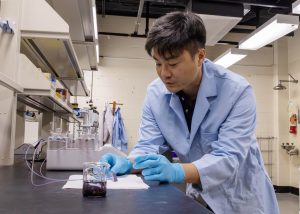 Some of the most impactful research at the Bagley College of Engineering is happening in spaces smaller than a human hair.
That’s where Sungu Kim, an assistant professor in the Michael W. Hall School of Mechanical Engineering and his students in the Laboratory for Intelligent Fluidic Transport, or LIFT Lab, are focused: studying how fluids behave at the micro- and nanoscale and using that knowledge to design technologies with real-world impact.
“At LIFT, we study how fluids behave at the micro- and nanoscale to develop new technologies for biomedicine and agriculture,” Kim said. “While the science operates on a tiny scale, the implications are anything but small.”
By gaining precise control over how fluids move in these environments, researchers can unlock faster diagnostics and use resources more efficiently. Just as importantly, they can develop scalable solutions to some of today’s most pressing challenges in health and food production.
That connection between fundamental research and practical application is central to the lab’s mission. One area of focus is neuromorphic iontronics, an emerging field where researchers build tiny systems that mimic how neurons communicate. The potential applications range from more energy-efficient computing to advanced biointerfaces. At the same time, the lab is addressing challenges much closer to home. In collaboration with partners, researchers are helping entomologists streamline protocols and improve accuracy through precision sample handling during the development and testing process, using lab-on-a-chip platforms, technologies that allow chemicals to be precisely controlled and analyzed while minimizing unintended environmental impact.
“Our work is strongly guided by real-world needs, particularly in agriculture,” Kim said, pointing to Mississippi’s largest industry as a key influence.
Kim explained that these partnerships help shape the lab’s focus on practical challenges and scalable, resource-efficient technologies, ensuring that the research doesn’t just stay theoretical but is positioned for real-world adoption. That emphasis on impact extends beyond the lab itself and into the state. Mississippi has historically had limited infrastructure in micro- and nanotechnology, but LIFT is helping to build that capacity while training students with highly specialized skills.
“By equipping students with advanced skills in fabrication and computation, we prepare them to contribute to local industry and help attract new high-tech opportunities to the region,” Kim noted.
In that way, the lab is not only advancing research but also investing in the future workforce and economic development in a state where agriculture drives the economy; that kind of innovation has real, everyday impact, from how crops are protected to how resources are conserved.
For students, the experience is intentionally hands-on and interdisciplinary. Working at the intersection of engineering, biology, and agriculture, they gain experience in everything from micro- and nanoscale fabrication to device design, testing, and computational modeling. That early exposure is already paying off. Within just three months of the lab’s launch, four undergraduate students presented their work at the Undergraduate Research Symposium, an achievement Kim sees as a reflection of both student enthusiasm and the lab’s strong culture of mentorship.
Looking ahead, the LIFT Lab is continuing to grow its capabilities and ambitions. Plans include developing more advanced neuromorphic systems, expanding infrastructure for micro- and nanofabrication, and creating new courses to support student learning in this rapidly evolving field. At the same time, collaborations with industry and academic partners remain a priority, helping to move innovations from concept to application.
“Even the smallest systems, when understood and engineered effectively, can have an outsized impact on the world around us.”
By Camille Carskadon