


MSU’s Additive Manufacturing Lab redefines component production
September 29, 2026
By Camille Carskadon and Aspen Harris
On a workbench inside Mississippi State University’s Additive Manufacturing Lab, a piece designed by students sits ready for its next challenge. Whether destined for a competition rocket, a student-built vehicle or an industry-sponsored project, the part represents more than a manufacturing breakthrough. It represents the future workforce learning to build the future of manufacturing.
Located within the Center for Advanced Vehicular Systems, the Additive Manufacturing Lab helps researchers and industry partners explore new ways to design, produce and qualify components for applications ranging from aerospace and defense to energy and advanced manufacturing. At the same time, students gain hands-on experience with technologies that are transforming how products are made around the world.
Often referred to as 3D printing, additive manufacturing (AM) has evolved far beyond the desktop machines many people associate with the technology. By building components layer by layer, manufacturers can create complex geometries, reduce material waste, shorten supply chains and produce parts that would be difficult or even impossible to manufacture using traditional methods.
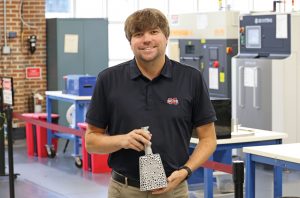
Matthew Priddy is an associate professor in the Mississippi State Bagley College of Engineering. (Photo by Kristen Polk)
“At this point, I can’t think of any industry that is not either using or attempting to use 3D printing / additive manufacturing,” said Matthew Priddy, associate professor in the MSU Bagley College of Engineering’s Michael W. Hall School of Mechanical Engineering and AM technical lead at CAVS.
As adoption grows, industries across Mississippi are exploring how additive manufacturing can improve efficiency, strengthen supply chains and address workforce challenges. Along the Mississippi Gulf Coast, shipbuilders and defense contractors are evaluating how the technology can support production and maintenance operations. Manufacturers are examining how additive processes can reduce lead times and create more resilient supply chains.
“They are seeking to figure out how to infuse additive manufacturing into their current work efforts to either reduce supply chain bottlenecks or complement the workers to automate processes,” Priddy said.
Helping industry navigate that transition is a key part of the lab’s mission.
For more than two decades, CAVS researchers have advanced additive manufacturing technologies while building expertise in material science, process development and manufacturing innovation. Today, the lab houses multiple metals-based additive manufacturing platforms capable of producing components using laser- or welding- based processes to print ferrous and non-ferrous metals.
But the lab’s impact extends beyond producing parts. Researchers are focused on understanding how materials behave during production, how manufacturing processes can be optimized, and how data can be used to improve quality and reliability. Their work combines advanced manufacturing with modeling and simulation, materials characterization, and real-time process monitoring.
One area receiving increasing attention is the use of data analytics and artificial intelligence to better understand what happens during an AM build. As additive manufacturing systems generate large amounts of information, MSU researchers are developing ways to use that data to predict performance, improve consistency and identify potential issues before they become costly problems.
The ability to evaluate components as they are produced could accelerate qualification and certification processes while reducing reliance on expensive post- production testing, an important advancement for industries where reliability is critical.
Space Cowboys’ additively manufactured aft truss
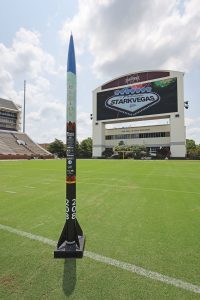
Mississippi State's Space Cowboys rocketry team designed Helios in 2025. (Photo by Kristen Polk)
When Mississippi State’s Space Cowboys rocketry team set out to design Helios, its competition rocket for the 2025 International Rocket Engineering Competition, it was faced with a familiar aerospace challenge -- building a component strong enough to withstand full motor thrust while staying light enough to not compromise altitude.
The Space Cowboys’ solution was to consolidate the traditional two-part thrust ring and truss into a single, additively manufactured aft truss. Additive manufacturing was selected for the component as it was large and geometrically complex, but comprised of thin features, making traditional machining costly and time-consuming.
The result spoke for itself. The redesigned aft truss cut part count and weight, which helped Helios push several hundred feet higher than earlier vehicles. At competition, Helios took first place in the 30,000-foot commercial off-the-shelf rocket motor category. One judge remarked he’d never seen anything quite like the truss before.
Space Cowboys led the design, analysis and testing of the final part, while students within the Additive Manufacturing Lab helped fabricate the part using a Renishaw laser powder bed fusion system, reflecting CAVS role in student workforce development.
Training the next generation
While the technology itself is impressive, the people behind it remain at the center of the lab’s success. Mississippi State and the Bagley College of Engineering place a strong emphasis on student involvement, and the Additive Manufacturing Lab is no exception.
“Our mission in the lab is to have students involved in all aspects of projects,” Priddy said.
Students gain experience operating equipment, preparing builds, conducting experiments, analyzing data and supporting industry-sponsored projects. Undergraduate researchers work alongside graduate students, faculty and industry partners, contributing to projects that have real-world applications.
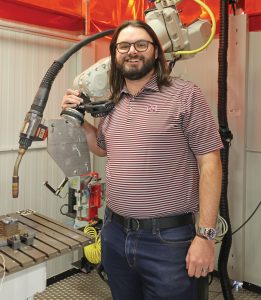
Logan Betts first joined the Additive Manufacturing Lab as an undergraduate researcher. (Photo by Kristen Polk)
For Logan Betts, that opportunity helped shape his entire career.
Betts first joined the lab as an undergraduate researcher before pursuing graduate studies focused on additive manufacturing. After earning his doctorate, he now serves as a research engineer within the lab.
His path is one of many that reflect the facility’s role in developing talent for a rapidly growing industry.
“There’s a huge emphasis to have students involved in every part of the process,” Betts said.
Students are not simply observing research. They are actively operating equipment, troubleshooting challenges, supporting projects and helping develop solutions alongside experienced researchers. That experience is especially valuable because the lab equipment mirrors what students may encounter after graduation.
“The same technology we have in the lab are the exact same machines that you could work with in industry, so the skills the students learn in the AM lab directly translate to the workplace,” Priddy said.
In many research environments, students work with scaled-down systems designed primarily for experimentation. In additive manufacturing, MSU students gain experience using production-ready equipment and industry-standard processes.
The result is a workforce pipeline that benefits both students and employers. Graduates leave MSU with experience that translates directly into industry settings, while companies gain access to engineers who understand the technologies reshaping modern manufacturing.
As manufacturers seek greater flexibility, stronger supply chains and new approaches to production, additive manufacturing is expected to play an increasingly important role. Researchers at Mississippi State continue to expand the lab’s capabilities, explore emerging technologies and develop the knowledge needed to support that growth.
For the students working inside the lab each day, the future of manufacturing is not a distant concept. It is something they help create with every build, every experiment and every breakthrough.
Layer by layer, they are helping shape what comes next.