


Mississippi State University Department of Electrical and Computer Engineering hosts Spring 2026 Design Showcases, announces winners
July 8, 2026
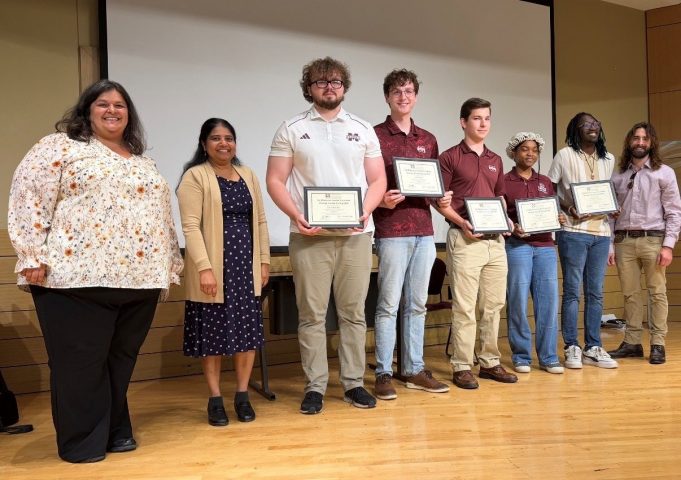
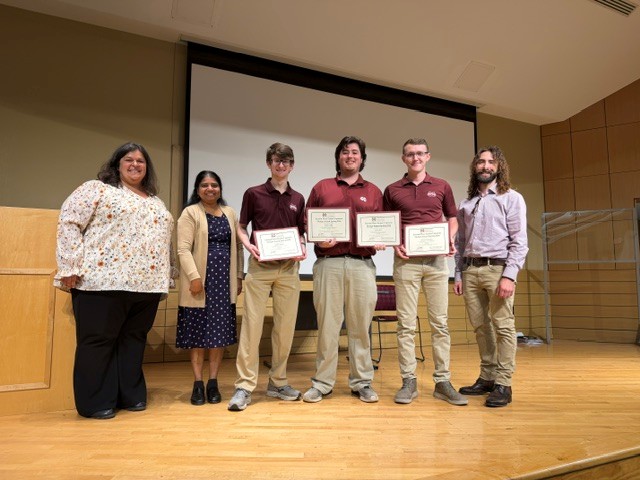
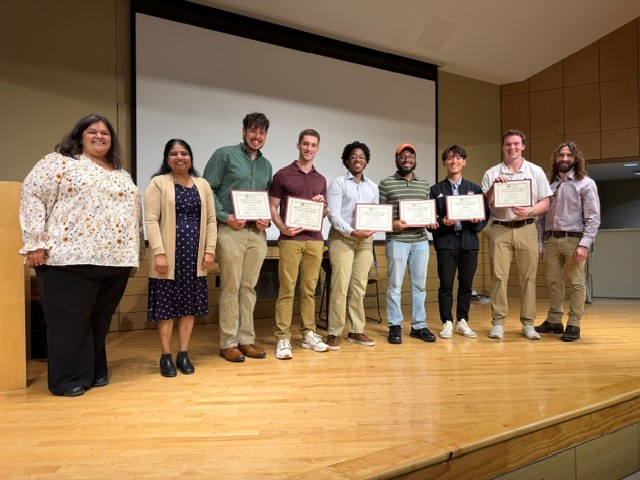
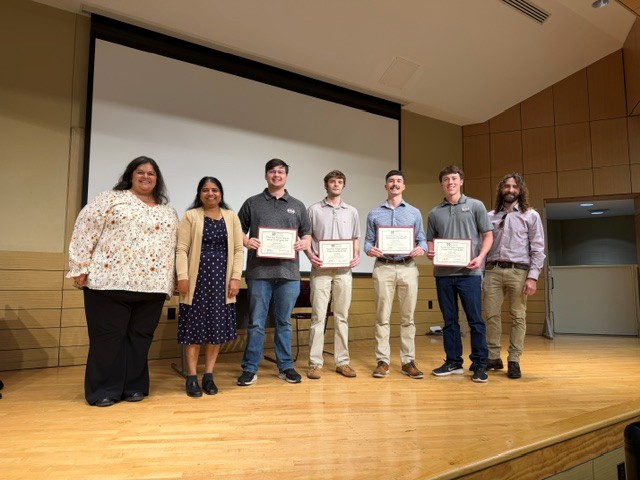
STARKVILLE, Miss.— The Department of Electrical and Computer Engineering, located in the MSU Bagley College of Engineering, hosted its Spring 2026 Design Showcases on Friday, May 8 and Monday, May 11, 2026.
The showcase, which occurs in the fall and spring semesters, featured teams from the department’s Foundations in Design and Capstone Design II classes. Students in these courses used their knowledge and skills to incorporate appropriate engineering standards, all while fabricating designs, testing projects and demonstrating fully functional projects. During the showcase, each team had the opportunity to present its projects to the audience. First, second and third places were awarded in both the Foundations in Design and Capstone Design II courses.
The team that placed first in the Capstone Design II showcase received the Ed Blakeslee Senior Capstone Design Award and $1,000. The Ed Blakeslee Senior Capstone Design Award was made possible through the generous donation of electrical engineer alumnus Ed Blakeslee. All projects and descriptions are listed below, starting with first, second and third place.
Capstone Design II
First Place/Ed Blakeslee Senior Capstone Design Award: William Hawkins, Tamya Lowe, David Metcalfe, Cody Swann and Brayden Wicks
Project: The MagnaChess is an advanced chess game board which is optionally voice-activated and can detect and magnetically move game pieces across the board. With its optional online connectivity, users can compete against users anywhere in the world via Lichess online and watch their opponent's pieces advance on the board to reflect their latest move. When the game is over, use the AI-assisted coaching tool to analyze your game and improve your strategy.
Project Advisor: Aly Abdalla
Second Place (tie): Conner Davis, Eli Frazure, Brendan Harrison and Robert Loflin
Project: The Satel-Lite is an interactive STEM game designed to spark interest in and educate children on small satellite technology. With its intuitive interface and swappable accessory modules, kids can see and experiment with the types of sensors and data collected by CubeSat satellites. The device provides audible instructions and interactivity through a touchscreen display, and its current modules include a battery module, Bluetooth module, camera module, and environmental sensor module.
Project Advisor: Jean Mohammadi-Aragh
Second Place (tie): John Alliston, Tuan Dao, Noah Gregory, Brian McLaurin, Kenneth McGowan and Brittin Perdue
Project: As part of this year's Capstone course, five teams opted to compete in a small robotics competition. This timed, multi-faceted competition features a variety of tasks including collecting game pieces, sorting them by color, and distributing them to specific areas of the board. The competition also features ducks and statue pedestals which can be stacked for additional points. The five competing teams have selected a variety of approaches, but all robots must act without human input during the competition.
Project Advisor: Christopher Hudson
Third Place: Jackson Farmer, Aidan McKeon, Asa Rushing and Garrett Wallis
Project: The Garbage Retrieval and Environmental Guardian (G.R.E.G.) is an all-terrain robot designed to be deployed to parks and roadways for autonomous trash collecting. Its durable treads help it traverse many types of terrain, while the camera vision and trash collection systems identify and capture litter in the environment.
Project Advisor: Yu Luo
Foundations in Design
First Place: Luke Barfield, Daniel Pridgen, Brijes Mandal and Shawndel Daniel
Project: OccuSense Smart Tourniquet is a simple, automated safety device to modernize hemorrhaging control in any environment. The system addresses mechanical and clinical failures in manual hemorrhaging control by using automated precision to maintain specific pressures and including a high-priority interrupt for emergency release.
Project Advisors: Jeremy Ray
Second Place: Conrado Jocson, Andrew Mascari, Hayden Fulkerson and Gage Williams
Project: The Tempo Tap is designed to help musicians train and stay on rhythm. Its adjustable arm band hides a vibration motor which silently taps a gentle cadence, keeping rhythm at a wide range of beats per minute in adjustable time signatures. An LED and speaker provide additional, but optional feedback. The user interface contains knobs and buttons for adjusting the BPM and time signature, while an LCD display provides live visual confirmation of the rhythm.
Project Advisor: Scott Sisson
Third Place: Andrew Voigt, Caden Tran, Cameron Long and Nathan Meador
Project: CampBuddy uses environmental monitoring and motion detection to improve tent comfort and sleep quality to increase the enjoyability of the overall camping experience. Sleeping spaces are more comfortable with automatically adjusted fan speeds determined by temperature and humidity data. Uses can sleep more soundly as the system also monitors the environment outside the tent and will alert campers to the presence of intruders
Project Advisor: Oliver Higginbotham
Honorable Mention: Andrew Hopkins, Michael Kirakosyan, Collin McBeth and Judah Murphy
Project: The Flow State device is designed to help monitor indoor residential air quality. It discreetly integrates into existing air conditioning systems and monitors air quality before and after the household filter, alerting when air quality declines or the filter needs replacing. This ensures the filter replacement rate aligns with your home's needs and helps extend the life and health of you and your air conditioning system.
Project Advisor: Scott Sisson
Honorable Mention: Jacob Bullock, Avi Ghimire, Adi Mulay and Braden Pierce
Project: The Fish Bite Detector enhances the fishing experience by accurately detecting bites and alerting the fisher when the rod is in an active bite, reducing missed strikes. The system improves on current simplistic systems by reducing the number of false bite detections due to wind or rod movement.
Project Advisor: Jacob Robinson
The Department of Electrical and Computer Engineering is on Facebook; YouTube; Instagram; Twitter; and Linkedin.
The Bagley College of Engineering is online at www.bagley.msstate.edu and can be found on Facebook, Twitter, Instagram and YouTube at @msuengineering.
Mississippi State University is taking care of what matters. Learn more at www.msstate.edu.
By: Camille Carskadon