


Aiming for orbit: CubeSat team earns national opportunity while pursuing Mississippi’s first satellite
October 13, 2026
By Camille Carskadon
For members of CubeSat at Mississippi State University, the journey to space is already underway.
Back in the spring, the student-led organization earned a place in the highly competitive University Nanosatellite Program, a milestone that advances its long-term goal of designing, launching and operating Mississippi’s first satellite. Along the way, students are gaining hands-on experience in systems engineering, mission planning, testing and project management while tackling challenges that mirror those faced by aerospace professionals.
Founded in 2019 by a group of aerospace engineering students, CubeSat at Mississippi State has grown into a multidisciplinary organization of more than 35 active members united by a shared interest in space exploration and engineering. The team’s long-term goal is ambitious: design, launch and operate Mississippi’s first satellite while providing students with hands-on experience in every phase of the engineering process.
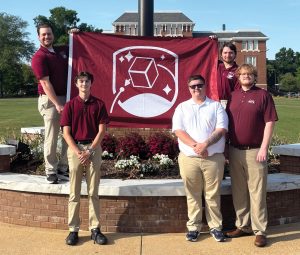
CubeSat, a student-led organization in the Department of Aerospace Engineering, earned a place in the highly competitive University Nanosatellite Program. (Photo submitted)
The team’s proposed spacecraft, known as 1-Mississippi, is a 3U CubeSat designed to use remote-sensing technology to identify environmental hazards such as wildfires, harmful algal blooms and gaseous emissions. Beyond its potential research applications, the project offers students an opportunity to contribute to a milestone achievement for the state.
“Mississippi is one of the only states that has never launched an educational satellite,” said Rob Wolz, professor of practice in the Department of Aerospace Engineering and the team’s advisor. “Our initiative is trying to address this technological divide.”
This year, the team took a significant step toward that goal when it was selected to participate in the University Nanosatellite Program, a highly competitive initiative supported by the Air Force Research Laboratory and NASA. MSU was one of only eight universities selected for this year’s cohort.
The program provides mentorship from aerospace professionals, military researchers and satellite subject- matter experts while helping student teams refine mission concepts and early-stage satellite designs.
For CubeSat members, the opportunity offers far more than technical experience. Students spent the summer participating in workshops, developing mission requirements and refining design concepts while learning industry-standard systems engineering practices.
The experience reflects the organization’s broader mission of providing students with opportunities to move beyond theory and engage in the realities of engineering development.
Organized much like a small company, CubeSat includes student leadership positions, such as a president, who also serves as program manager and chief engineer, along with technical teams focused on structures, instrumentation and guidance, navigation, and control systems. The organization has since expanded into three major development branches: balloon missions, ground-station operations and satellite development. Students take an active role in design, testing and project execution while gaining experience in systems engineering, documentation, project management, and multidisciplinary collaboration.
Those experiences are increasingly valuable as students prepare to enter the workforce.
“Students who build real-world capabilities demonstrate not only an understanding of theory but also the ability to work within a team to accomplish a practical goal,” Wolz said.
The knowledge gained through the University Nanosatellite Program will extend beyond the students who took part this summer. Team members are expected to share what they learn with the broader organization, helping strengthen the program’s technical capabilities and furthering progress toward its long-term objectives.
For CubeSat, success is measured not only by the possibility of launching a satellite but also by the opportunities created for students along the way. Each design review, test campaign and engineering challenge provides another chance to develop the skills and experience that define successful engineers.
And while the launch of 1-Mississippi remains a future goal, the team continues to move closer to a moment its members hope will one day make history: watching Mississippi’s first satellite deploy into orbit and transmit data back to a ground station on the Mississippi State campus.