


MSU hosts Ecuadorian researchers to advance irrigation water planning
October 16, 2026
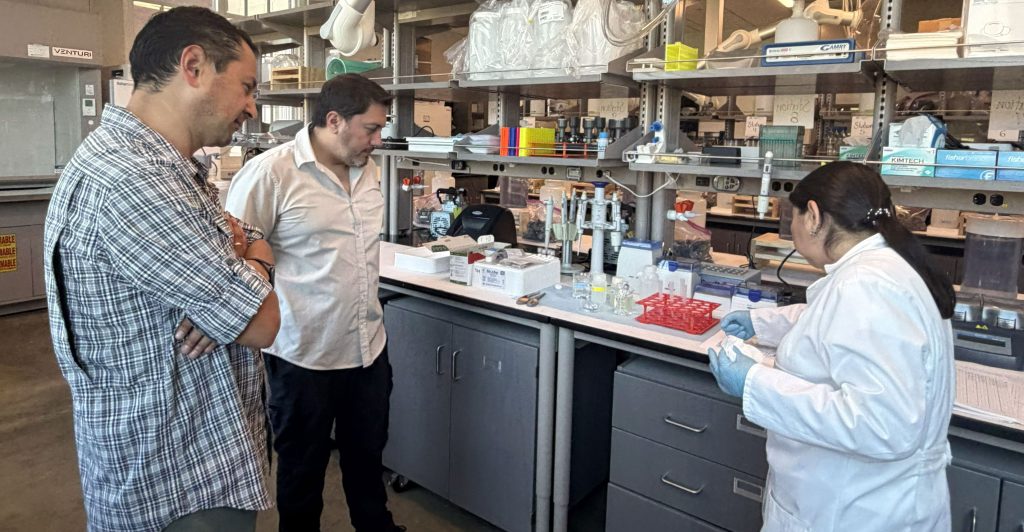
From left, Universidad Central del Ecuador professors Jorge Espinosa Marín and Renato Haro and MSU’s Sandra Ortega-Achury take part in water quality laboratory analysis training. Ortega-Achury, research associate and laboratory coordinator for the Watersheds and Water Quality Research Lab in the Richard A. Rula School of Civil and Environmental Engineering, tested for the nutrients phosphorus and nitrogen and explained the analysis procedure. Espinosa and Haro then conducted individual analyses on water samples from Catalpa Creek. (Photo submitted)
Contact: Chris Whitaker
STARKVILLE, Miss.—Mississippi State hosted two faculty members from Universidad Central del Ecuador's College of Agricultural Sciences in September as part of an ongoing international research collaboration to help determine whether farms in northern Ecuador will have enough water in the years ahead.
Working with John Ramirez-Avila, associate professor in the Richard A. Rula School of Civil and Environmental Engineering and head of the Watersheds and Water Quality Research Lab, the visiting faculty participated in technical training and knowledge-exchange activities. The training covered how to measure, test and manage water supplies and how to use computer models to predict how much water farms will need.
“Beyond the technical training, the visit provides an opportunity to strengthen institutional partnerships between Mississippi State University and Universidad Central del Ecuador, promote collaborative research and foster knowledge exchange to advance sustainable water management and agricultural resilience,” Ramirez-Avila said.
Mississippi State’s Bagley College of Engineering hosted two faculty members from Universidad Central del Ecuador’s College of Agricultural Sciences in September as part of an ongoing international research collaboration. From left, Robert Green, associate dean of academics; Jorge Andres Espinosa Marín, professor at Universidad Central del Ecuador; Dave Ford, dean and Earnest W. & Mary Ann Deavenport, Jr. Chair; Renato Haro, professor at Universidad Central del Ecuador; and John Ramirez-Avila, associate professor and head of the Watersheds and Water Quality Research Lab in the Richard A. Rula School of Civil and Environmental Engineering. (Photo submitted)
The visit by Jorge Andres Espinosa Marín and Renato Haro grew out of a partnership that began in 2021, when Espinosa worked with Ramirez-Avila on an Engineers Without Borders water project in Santa Teresita, Ecuador.
Because of COVID-19 travel restrictions, Espinosa provided local support that helped the MSU team continue its project. When travel resumed, the team met with Espinosa in Quito, Ecuador, and discussed common interests in hydrology and water resources.
“Those early discussions led to student mentoring, technical exchanges and the development of a research proposal that later received funding,” Espinosa said. “The collaboration has grown organically around shared interests in hydrology, water quality, watershed management and environmental sustainability.”
The resulting project, funded by the Fund for Research in Agrobiodiversity, Seeds and Sustainable Agriculture, is building a computer model to estimate water supply and farm demand in the Cayambe-Pedro Moncayo Irrigation Canal in northern Ecuador through 2030. Collaborators also include Texas A&M University and Universidad del Desarrollo in Chile.
“The effort combines hydrologic modeling, climate and land-use assessments, and agricultural systems analysis to support sustainable water management, improve irrigation planning and strengthen decision-making for future agricultural production,” Haro said.
The Cayambe-Pedro Moncayo irrigation system supports an important agricultural region, but Espinosa said climate, land-use and agricultural changes may affect how much water is available and how much farms need.
“MSU is helping develop and evaluate tools that estimate how much water the irrigation system can provide and how much water agriculture will need in the future, so local stakeholders can better plan for sustainable water use and agricultural production,” he said.
Ramirez-Avila said the collaboration also benefits Mississippi and MSU by expanding international research partnerships and creating opportunities for faculty and student engagement in global water resources challenges.
“The partnership helps position MSU and the Watersheds and Water Quality Research Lab as valued contributors to addressing water and agricultural sustainability challenges both locally and internationally,” he said.